Learn how to improve front door home security with the right composite door features, without overspending on unnecessary upgrades.
What You’ll Learn:
- Understand which composite door features genuinely improve front door strength and resistance to attack
- Learn how locks and cylinders directly impact real-world home security performance
- Discover which security upgrades are worthwhile and which features are simply unnecessary extras
- Know how to specify a secure front door while keeping costs sensible and controlled
(Estimated Reading Time: 5-6 Minutes)
INTRODUCTION
Upgrading your front door is one of the most effective ways to improve home security, but it’s also where many homeowners worry about cost. The concern is understandable: does choosing a budget-friendly option mean compromising on protection?
The reality is more reassuring. A well-specified composite front door can offer excellent home security without a premium price tag. The challenge is knowing which features genuinely make a difference, and which are simply marketing extras.
Homeowners exploring the Global Door range often discover that strong security doesn’t come from expensive add-ons, but from getting the fundamentals right: door construction, locking systems, and correct specification.
In this guide, we’ll explain which composite door features actually protect your home, where you can save money safely, and how to design a secure front door that fits your budget.
Why the front door is the most important security upgrade
Most burglaries still involve forced entry through a door, and the front door remains the primary target.
Older doors often fail for simple reasons. Weak frames, misaligned locks, thin panels, or outdated cylinders make entry quicker than most homeowners realise.
Upgrading to a composite front door addresses all of these vulnerabilities in one go. But only if the specification is right.
The core of a secure composite door
Door slab strength
A secure composite door starts with the slab itself.
Quality composite doors use a rigid insulated core bonded to a GRP outer skin. This creates a door that resists flexing and impact far better than hollow or thin-panel doors.
If the door feels light or bends under pressure, security has already been compromised.
Thickness matters
Most good composite doors are around 44mm thick or more. This added thickness improves both strength and lock performance.
Thinner doors save money in manufacturing but reduce resistance to forced entry.
If security is a priority, thickness should not be sacrificed.
Locking systems that actually protect your home
Multi-point locking explained simply
A multi-point lock secures the door at several points along the frame when locked, rather than relying on a single latch.
This spreads force across the entire door and frame, making it far harder to force open.
Any secure composite front door should include a multi-point locking system as standard.
Cylinder quality is critical
The lock cylinder is often the weakest link.
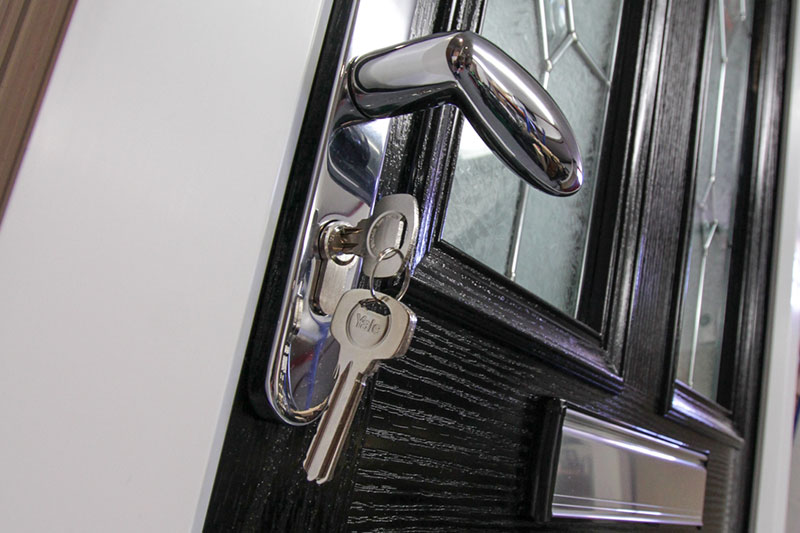
Look for cylinders that resist lock snapping, bumping, drilling, and picking. Many modern composite doors are supplied with high-security cylinders as standard.
Upgrading to a recognised high-security cylinder is one of the most cost-effective security improvements you can make.
Frames and hinges are part of the security system
Reinforced frames
A strong door in a weak frame is pointless.
Composite doors should be installed into reinforced frames that resist flexing under force. Steel-reinforced uPVC frames are common and effective.
A properly specified frame keeps the door aligned and the locks engaged correctly.
Hinges and hinge bolts
Modern composite doors use heavy-duty hinges designed to support the weight of the door.
Many also include hinge-side security bolts, which prevent the door being removed even if the hinges are attacked.
These features are often included as standard and should not be removed to save cost.
Glazing and security do not conflict
Toughened and sealed glass units
If your front door includes glass, it should be double glazed and toughened.
Modern composite door glazing is internally beaded, meaning it cannot be removed from the outside.
This ensures that adding light to your entrance does not weaken security.
Choosing glazing wisely on a budget
Smaller glazed areas reduce risk and cost. Frosted or patterned glass provides privacy without sacrificing strength.
There is rarely a need for triple glazing or oversized panels on a budget-focused front door.
What security certifications actually mean
PAS 24 in plain English
PAS 24 is a UK standard that tests doors against common forced entry methods.
A composite door that meets PAS 24 has been independently assessed for security performance.
While not mandatory for all homes, it is a strong indicator of a well-built door.
Secured by Design
Secured by Design is a police-backed scheme that recognises products designed to deter crime.
Many composite doors meet this standard, but it’s worth checking rather than assuming.
Security features you don’t need to overpay for
Not all upgrades improve security proportionally.
Smart locks are convenient but not essential for physical security.
Decorative hinge covers add no real protection.
Excessively complex glazing does not improve resistance.
Focus on core structure, locking, and fitting rather than flashy extras.
Installation is as important as the door itself
Even the best composite door can be undermined by poor installation.
Gaps around the frame, misaligned locks, and poorly sealed thresholds reduce security dramatically.
Professional installation ensures the door performs as designed and maintains lock alignment long-term.
DIY installation can work, but only if carried out accurately and carefully.
How to spec a secure composite front door on a budget
To maximise security without overspending:
Choose a solid, thick door slab.
Ensure multi-point locking is standard.
Select a high-security cylinder.
Confirm reinforced frames and hinge bolts.
Keep glazing modest.
Prioritise correct installation.
These choices deliver real-world protection without inflating the price.
Using an online designer to control security and cost
An online door designer allows you to see which security features are included and which are optional.
This transparency helps avoid paying for unnecessary upgrades while ensuring the essentials are covered.
You can design a secure composite door, adjust the specification, and see the price update instantly.
Final thoughts and next steps
Front door security doesn’t require a premium budget. It requires the right specification.
A well-built composite front door delivers excellent protection, strong insulation, and long-term reliability without unnecessary extras.
If you’re ready to upgrade your front door securely and sensibly, the best next step is to use the Global Door online designer. Build your door, confirm the security features, and get an instant quote tailored to your choices.
🛒 Browse the full collection at Global Door
📞 Or call 01642 309576 for expert guidance and a no-pressure quote.
In a rush? Why not contact us via Whatsapp
FAQ’s
Q1: What matters most for front door security?
A1: A rigid door slab, a multi-point lock, a high-security cylinder, a reinforced frame, and correct installation matter most.
Q2: Are smart locks necessary for a secure door?
A2: Not necessarily. Physical security from strong construction and good locks is usually the foundation. Smart locks are optional convenience.
Q3: Does glazing make a door less secure?
A3: Not if it’s toughened, double glazed, internally beaded, and combined with strong locks and a rigid door slab.
Q4: What’s the most cost-effective security upgrade?
A4: A high-quality anti-snap cylinder is often one of the best-value upgrades if it isn’t already included.